



In the age of the peripatetic mercenary in football, supporters cling extra tight to their homemade heroes. From Spurs to Scunthorpe, few songs are belted out with as much feeling as “he’s one of our own”. Unsurprising, given the decreasing importance of a club’s bond with its own community, at least in the eyes of those in charge. A home-grown star holds a special place in any club’s folklore, so here goes our top 10…
10. Peter Shilton, Leicester City
It was Gordon Banks who spotted the potential in the teenage Shilton, who joined Leicester at the age of 13. Shilton would go on to succeed the World Cup-winning Banks, who was moved on to Stoke City to make way for the younger man. No World Cup win for Shilton, although he went to three with England and made more than 1,000 appearances for six clubs in a career of astonishing longevity. No British footballer has made more than his 1,387 career appearances, the last of which came aged 47 for Leyton Orient.
9. Harry Kane, Tottenham Hotspur
You would have got long odds on Kane making a list like this in 2011, when on loan at Leyton Orient. Spells at Millwall, Norwich City and Leicester would follow before his thrilling hot streak after Tim Sherwood promoted him to his first team in the spring of 2014. That hot streak has never really abated and Kane left Spurs nine years later with a claim to being the club’s best-ever player. Only trails Alan Shearer in the all-time Premier League top scorer list but is well clear on his own for his country. No need to mention those childhood pictures in an Arsenal shirt, we all make mistakes.
8. Jack Charlton, Leeds United
When brother Bobby (never fear, we will get to him later) was signed by Manchester United, Jack was taking part in national service with the Household Cavalry. Offered trials at Leeds at 15, Jack said no, preferring to join his father in the mines. The unpleasant realities of that working life gave him pause, and he revisited football as an option. The day of his new trial clashed with an interview to join the police force. Jack chose Leeds and never left, making a record 773 appearances over 21 seasons with the club, winning every domestic trophy.
7. Matt Le Tissier, Southampton
Most clubs have their share of “one that got away” stories. How different things might have been had Oxford United thought more of a 15-year-old trialist from Guernsey in 1983. Le Tissier returned home to the Channel Islands but signed YTS forms at Southampton two years later and became the rarest genre of one-club man – a player who clearly could have upgraded his team but chose to stay put. Never won a trophy or played in Europe but was responsible for half a dozen of the best goals English football has ever seen. Plus innumerable happy memories for Southampton and neutral fans alike.
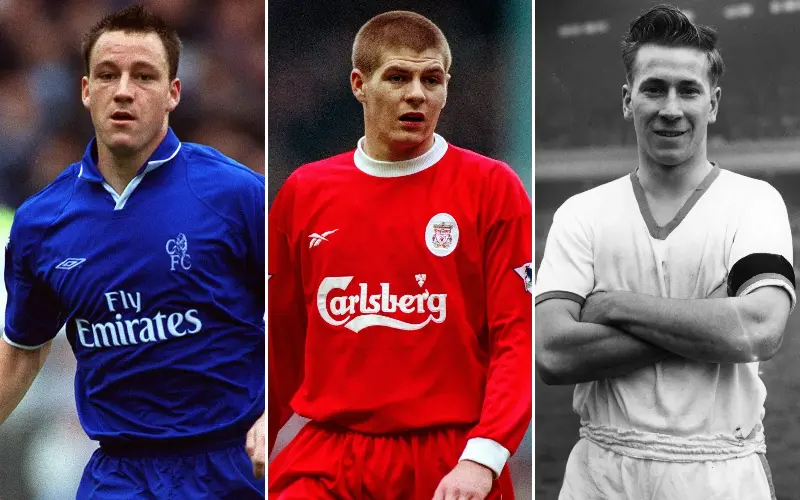
6. John Terry, Chelsea
Some players become legendary at a club without ever fully shedding their past. Few have as strong a bond with the modern Chelsea as Terry’s team-mate Frank Lampard, but it is still easy to picture him in the colours of his first club West Ham United. You cannot say the same for Terry, despite him spending four years in the West Ham academy playing in midfield. He moved to Chelsea at 14, so, unlike Lampard, never made a first-team appearance in claret and blue. He did wear those colours in the end, with his career wind-down season in the Championship with Aston Villa. Still hard to see him in anything other than blue, because Terry was Chelsea through and through. Captain and leader for the club’s most successful era.
5. Tony Adams, Arsenal
Picked up as a schoolboy in 1980, Adams made an inauspicious start at Arsenal. On the day of his first-team debut at 17 he gave the ball away with one of his first touches, leading to a goal for Sunderland. He also put his shorts on back to front. From there a slow burn, gradually shedding a reputation for awkwardness which earned him the cruel nickname “donkey” by conquering his limitations as a player. Also tackled his alcoholism before winning the Double in 1998. By then, and for the rest of his one-club career, he had a different nickname: Mr Arsenal.
4. Steven Gerrard, Liverpool
Jamie Carragher would have a fair claim to a spot on an expanded version of this list, so his words have significant weight when assessing his great team-mate. When Gerrard returned to Anfield as manager of Aston Villa in 2021, Carragher said he “will emerge on to the Anfield touchline and receive an ovation unlike any other returning Liverpool hero. He will do so because he is the greatest player in the club’s history.” Deserved more than the ill-timed slip against Chelsea which denied him a Premier League trophy but he put a listing club on his shoulders for much of his career, never more so than in Istanbul in 2005.
3. Bobby Charlton, Manchester United
Synonymous with United’s identity in their many glorious pre-Ferguson days, but transcended even that. A generation of sporting agnostics could summon him in their mind’s eye when thinking “footballer”. Mixed elegance with strength and profound decency. As Jim White wrote when he died in 2023, he “represented an Englishness that was universally recognised and universally admired”. Signed as a schoolboy and mentored by Jimmy Murphy, he was back in the first team within a month of the Munich air disaster of 1958. His goalscoring record was only overtaken in the last days of Wayne Rooney at Old Trafford.
2. Bobby Moore, West Ham United
Some players are so influential they define a club’s entire outlook. Born less than three miles from Upton Park, Moore joined West Ham at 15, becoming the ultimate urbane defender. Unruffled, graceful, ineffably cool. Read the game in a manner unmatched for his era. Legs had gone by the time he joined Fulham in 1974 but on brain alone he was still one of the country’s best centre-backs. There is enduring anger about his underappreciation by the Football Association in the years that followed the national team’s high point. Under-appreciation has never been an issue with the supporters of the club which made him.
1. Ryan Giggs, Manchester United
The crop of youth talent at Manchester United in 1990 was not once in a generation. It was rarer than that. David Beckham and Paul Scholes may have reached higher peaks, Gary Neville, for all that he likes to poke fun at his own playing career, was arguably more consistent. No one can compete with Giggs’ honours list. Twenty-five major trophies (34 if you want to include Community Shields) make him the most decorated player in English football history. Hard to imagine anyone will match his 13 Premier League titles, or his 963 United appearances.