



Picture the view. In the foreground, a lawn as finely manicured as George Clooney’s jaw. Behind, a sandy beach shaded by palms. Beyond, the Adriatic, cool and inviting.
From the vantage point of my balcony at the One&Only Portonovi, I could see why so many A-listers have swapped St Tropez for the Bay of Kotor. Brad Pitt, Beyoncé and Penelope Cruz have all visited in recent years.
Mere mortals have discovered it too, with Montenegro trending on social media for the last five years. Your friend has probably been there recently. If they haven’t, their friend definitely has.
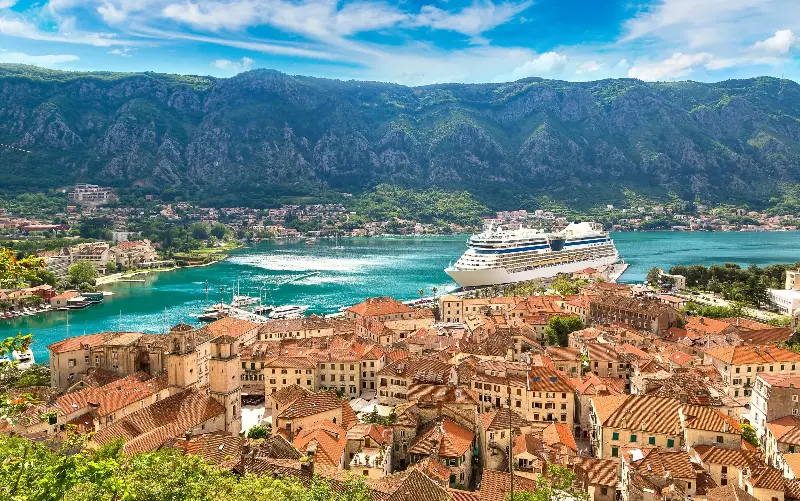
But then, the view changed. A cruise ship – one of those very large ones that looks like a starship that missed its landing pad – crept around the headland. I checked my cruise locator app and saw three others in the vicinity and dozens more hovering along the Dalmatian coast.
The world has discovered this magnificent fjord, and it will soon become even more popular with this month’s arrival of new British Airways flights from Heathrow to Tivat. Can the Bay of Kotor cope with its rising popularity?
Like a Norwegian fjord on the Adriatic
The coastal road from Portonovi to Perast keeps close to the shore, with the karst mountains, water and light rearranging to form new perspectives. If it weren’t for the Dalmatian terracotta villages, you could well be driving alongside an Alpine lake or into a Norwegian fjord.
It was mid-morning and the tourists were already drifting into Perast. The only wheeled things permitted on the promenade were electric buggies and rolling luggage, creating the illusion that you are in a high-end resort and not, in fact, a living village.
Most explore on foot, wandering along the waterfront, up and down some steps, stopping for an espresso or spritz, and then hopping on a boat to one of the nearby islands. Our Lady of the Rocks and St George Island – both a little bigger than a few tennis courts – are just offshore.
I photographed each and boarded a local bus to Kotor, paying €2 for my ticket. Behind our vehicle, a red open-top tourist bus (€25 a ticket) followed us all the way.
‘There’s no space for all these people’
Kotor is often compared to Dubrovnik, another walled city 50 miles up the coast. But it has a different feel. Kotor is smaller and more compact, populated by an army of stray cats, with the remains of Romanesque Gothic palaces, squeezed between newer buildings like architectural hallucinations. And, looming above everything, is Mount Lovcen – lest you forget you are in a country whose name means “black mountain”.
At eye level, I saw the hallmarks of an old town whose economy has flipped to tourism. I walked past a Hard Rock Café and shops selling novelty T-shirts. An old medieval monastery has been turned into a shopping bazaar. The 12th century orthodox church has a warning on entry: no bikinis, no ice cream.
Vlasta Mandić, a local architect and chef, reflects on the days when Kotor struck a healthier balance with tourism.
“There used to be good contact with people, enough space for everyone. From around 1960 to the end of the 1980s, with the start of the crazy war, Kotor was perfect. I’m happy that I lived in that time,” she said.
“We have a lot of cruises. Can you imagine, this summer we will have 580 cruises in Kotor? Last summer was around 480. There’s no space for all those people. It’s good for business, but maybe a little bit less.”
After writing a cookbook of Montenegrin dishes, Vlasta spent a year lobbying local restaurateurs in the Old Town to add just two of her meals to their menus. Some took her up on the challenge. But she says, after two years, nearly all had reverted to pizzas and burgers. “This is a problem. Restaurants should care about this.”
Paying the price
A cruise ship arrived at the harbour and Kotor Old Town was filling up, to the point where crossing Trg od Oružja (Arms Square) became aptly elbowy. Groups coalesced around the clock tower and the “pyramid of shame” that was once used for public punishment. I ducked along some narrow alleyways to meet Jovan Ristić, the director of Kotor’s tourist organisation.
“Kotor is a town of world heritage, so we must be open to everyone. No matter of financial status, every guest is welcome,” he said, when I asked whether Kotor had become too crowded. I struggled to hear him clearly, because he had taken us to a place called The Pub, which smelt of last night’s lager spillages.
The first organised tour of Kotor was precisely 100 years ago. Tourism blossomed across the former Yugoslavia after the Second World War, and while Kotor Old Town suffered terrible destruction in the earthquake of 1979, it was spared the shelling and ground fighting that Dubrovnik endured in the 1990s.
After the Yugoslav wars, the tourists and cruise ships came. Arrivals topped one million for the first time in 2007, rising to 2.73 million in 2025. Such is the growth of the industry that Unesco has warned Kotor, on multiple occasions, that it could lose its world heritage status owing to excessive construction and uncontrolled tourism. They dodged that bullet. I wondered whether Mr Ristić believed things were now at a sustainable level.
“At this moment, it is not, but we are trying. We see all the problems and we know how to manage them,” he said.
There are plans, albeit future ones, to introduce electric buses and water taxis, and to build a new car park near the Old Town to ease summer congestion. However, Ristić says the city will not look to limit cruise arrivals until three new hotels close to the Old Town have been built. The first will open this summer, but the third will not be complete for another five to ten years.
“That will be the moment when we say: ‘Now it is time to reduce the number of cruise ships, and the length of time they can spend here,’” he said.
“In the future, I hope we will have the same entry fee system as Venice, but not at the level of €10 [the on-the-day fee in Venice]. When you come to a destination like this, it’s normal to pay some tax, because we need to repair a lot of things.”
I travelled back around the bay to Portonovi, which is too young to require repairs. Ten years ago, this was an abandoned military base. Now, after an £800m renovation, it is perhaps the most exclusive harbour on the Adriatic, and filled with superyachts.
Portonovi has gold-splashed outdoor lifts, if you’d rather not use the steps, and chill-out beats pumping out of speakers on the empty streets. The 238-berth marina feels like another world from Kotor, and far from the reality of existence for 99.99 per cent of humans. But the illusion of perfection shatters when you turn a corner towards the main road and see the skeleton of a new hotel, halted just last month after the developer was arrested because of a planning dispute.
Thanks to its unique isolation and geography, the Bay of Kotor has been vital for many civilisations: Illyrians, Romans, Byzantines, Venetians, Ottomans, and Habsburgs. Now, thanks to that same geography, it has entered the Tourism era. This inlet deserves every bit of love it receives. But as the tourism industry grows, work is required – today, not in ten years – to ensure it keeps its extraordinary appeal.
Where to stay
The One&Only Portonovi has a troop of attentive staff who welcome guests with a hand-on-heart gesture. Its Chenot Espace spa combines Chinese and western technology to offer relaxation, detox or rebalance. The pick of its three restaurants is Tapesake, a Japanese fusion restaurant bringing sushi and tapas in a lively waterfront setting. The hotel’s beach offers something that is hard to find on the rocky Montenegrin coast: (imported) sand. An excellent kids’ club is staffed by the wonderful Anya and Danijela, plus there’s an option for private boat excursions around the bay. Rooms start at £465 per night.
How to get there
This summer, the Bay of Kotor will get even more flights. BA launches a direct route from Heathrow to Tivat (20-minute drive from Kotor Old Town) on May 14, three times per week, with easyJet already flying from Gatwick, Manchester, Birmingham, Bristol and Luton. Alternatively you can fly into Podgorica (a two-hour drive from Kotor) or Dubrovnik (also a two-hour drive), although new EU Entry/Exit System (ESS) checks have slowed the border crossing in and out of Croatia.