



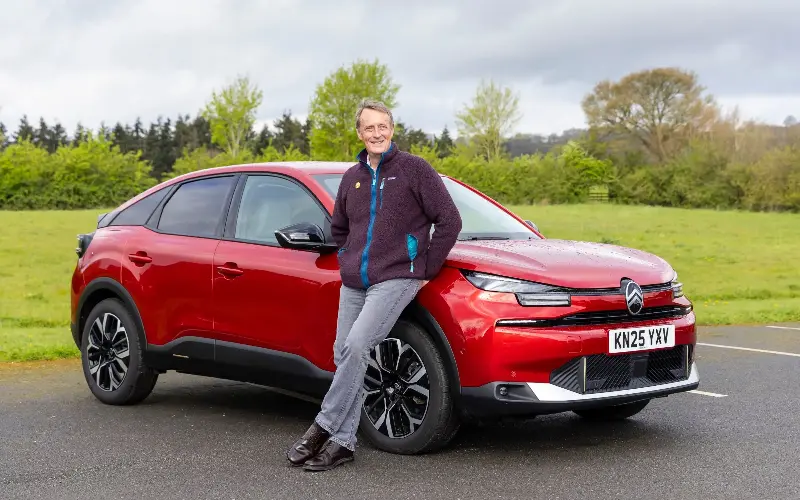
It’s a tough job but somebody has to do it: the latest Ferrari one day, an outrageous new Aston Martin the next. However, when I attend far-flung launches of new cars, regardless of how fast or expensive they are, I prefer to drive there in as fuss-free and unobtrusive manner as possible. For me, making steady yet swift progress while attracting the minimum amount of attention is the name of the high-mileage game.
Some vehicles don’t stand out but they do the job. The Citroën C4 is such a car; the kind of workhorse that gets overlooked soon after its launch, which is why I decided to revisit this unsung, recently face-lifted model. After all, Citroën must be doing something right: for the past 22 years the C4 has quietly been one of its best-sellers.
André Citroën’s brainchild has always been a bit of a financial black hole, with the company bailed out by Michelin in 1934 just 15 years after its inception before being sold to Peugeot in 1974. It now finds itself squeezed in the middle of the 14 brands comprising the Stellantis car-making giant and has suffered from corporate blandness.
As a result, Citroën’s design became a pale shadow of its idiosyncratic glories, with even the revered DS name being turned into a largely unsuccessful brand.
There is also brutal price competition in this non-premium area of the market, with Chinese rivals offering electric and plug-in hybrids at very low prices. These newcomers might not drive that well, but some people simply want something shiny for not much money. It’s not unreasonable for them to wonder what a “heritage brand” such as Citroën is for.
Stiff competition
C4 prices start at £24,815 and European rivals include the Volkswagen Taigo from £24,985, Ford Puma from £27,145, Nissan Juke from £24,265 and Renault Symbioz from £26,280. This Hybrid version of the C4 costs from £26,625 (two battery-powered versions are also available) and weighs 1,335kg.
The main changes in the recent facelift apply to the interior, which now sports a new fascia and seats. The seats are comfortable and supportive, and in the Max trims are heated and covered in quilted pleather. The same trim pack provides a head-up display showing speed and the prevailing limit, as well as sat nav directions.
It’s a high point of a fairly rudimentary touchscreen-based system, which is slow but simple. I suspect that C4 owners like the fact that there are separate controls for the heater and radio volume.
In the back there’s enough leg and head room for a couple of adults. At 380 litres the boot isn’t exactly large, but folding the rear seat backs extends it to 1,250 litres; I’ve had the seats folded quite often for transporting larger loads around the country.
On the road
The 1.2-litre, three-cylinder turbocharged engine often has to work hard given its 134bhp output. The mid-range is where it does its best work, partly thanks to the electric motor mounted in the gearbox and the 0.9kWh lithium-ion battery helping out when greater power is required. The electrical system alone can power the C4 at manoeuvring speeds.
Peak power is produced at 5,500rpm, but there’s little point in revving it since the engine gets quite frantic. Instead, stick to between 2,000 and 4,000rpm, where the peak torque is produced. Fuel consumption has remained steady at 53mpg against a WLTP claim of between 51.1 and 62.1mpg. The six-speed DCT gearbox works well, too. Early examples used to be a bit jerky at low speeds, but this one changes smoothly and quickly.
Although on paper the MacPherson-strut front and torsion-beam rear suspension set-up isn’t the optimum, the ride is better than it has a right to be, partly thanks to the comfort-enhancing hydraulic bump stops in the dampers.
Citroën has given it some handling as well. The steering requires a fair bit of twirling on tighter corners, but, on the whole, the C4 acquits itself well on brisk cross-country journeys.
Poor reputation
A reputation for poor reliability hasn’t helped Citroën’s cause, including the recent “stop-driving” recall because of faulty Takata airbags stranding more than 130,000 UK cars. The first of these 1.2-litre PureTech three-cylinder engines was known for throwing cambelts; they are now driven by chains.
Suspect electricals and software gremlins aren’t unknown, though. In fact, I’m writing this by the side of the road, not because the C4 isn’t working – it is – but the screens have blacked out while the software attempts to update itself in an area of Cornwall with negligible internet coverage. I could drive on, but the speedometer and the fuel gauge disappeared during the abortive update.
That said, What Car? and Motoreasy.com put Citroën in the middle of brands when it comes to reliability averages, and the C4 is no exception. This screen blackout is the sole failure I experienced while driving it.
The Telegraph verdict
The C4 Hybrid is an undemonstrative cruiser that’s economical, comfortable, well-priced and quite handsome, but also a bit boring. It is the sort of car you climb into after a tough day and let it do all the work, rather than look forward to driving. However, it’s also the kind of car you miss when it’s gone.
Given the amount of miles I cover, I rather liked this forgotten Citroën.
The facts
On test: Citroën C4 Max Hybrid 136 e-DCS6
Body style: five-door C-segment hatchback
On sale: now
How much? from £26,625 (£27,125 as tested)
How fast? 130mph, 0-62mph in 8sec
How economical? 51.1-62.1mpg (WLTP Combined) 53.5mpg on test
Engine & gearbox: 1.2 litre three-cylinder turbo petrol engine with 48-volt mild hybrid system, six-speed twin-clutch gearbox, front-wheel drive
Maximum power/torque: 134bhp/170lb ft
CO2 emissions: 125g/km (WLTP Combined)
VED: £455 first year, then £200
Warranty: three years/60,000 miles