



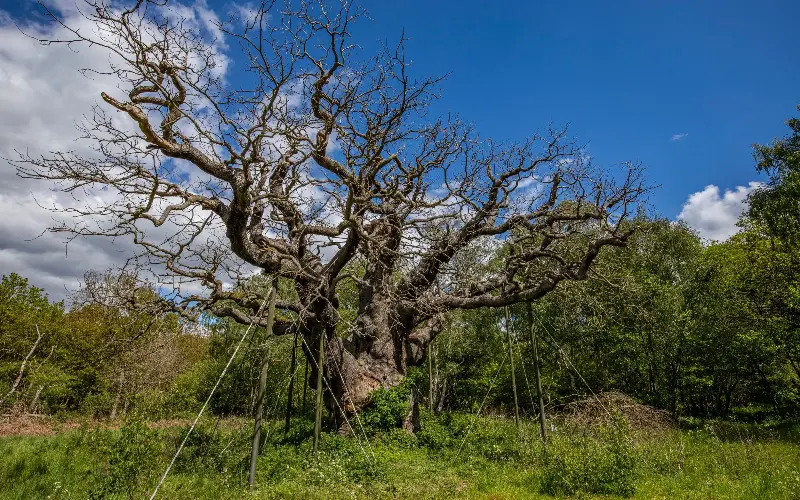
The 1,200-year-old oak tree said to have sheltered Robin Hood has died because of too many visitors.
The Major Oak in Sherwood Forest is the biggest oak in Britain and, according to legend, the swashbuckling outlaw and his band of Merry Men camped beneath its canopy and even hid inside its trunk.
But the footsteps of millions of sightseers have made the surrounding soil as solid as concrete, preventing rainwater, oxygen and nutrients from reaching the tree’s roots.
In recent years, conservationists had noticed that the quality and quantity of leaves were waning, but this spring, no new leaves emerged.
The RSPB said it believed the tree had died, blaming “huge amounts of human activity” exacerbated by droughts, heatwaves, coal mining and structural intervention to keep the tree upright.
“It’s devastating to accept,” said Chloe Ryder, the RSPB’s manager at Sherwood Forest.
“In recent years, surveys have focused on what’s happening underground, and what we discovered was a surprising and grave situation; a strangled and starved root system in total disconnect to its surrounding environment.”
The oak weighs an estimated 23 tons and has a girth of 33ft and a canopy of 92ft.
It has stood since before the Norman Conquest, but became a tourist attraction after being mentioned by Major Hayman Rooke, an English antiquarian, in his 1790 work Descriptions and Sketches of some Remarkable Oaks. The tree was dubbed “the Major Oak” in his honour.
Previously, it was known as “Cockpen Tree” because cockfighting was held beneath its branches and it was also called the Queen Oak and Robin Hood’s Oak.
Local folklore claimed the massive hollow trunk served as the secret hideout of Robin Hood and his Merry Men.
The legend, coupled with Rooke’s book, has drawn millions of visitors for the past 230 years, with the tree only fenced off to protect it from tourists by the 1970s.
But it has continued to suffer from unwanted attention and was nearly burnt down in 1982 when vandals started a fire in its hollow.
Well-meaning preservation efforts to keep the tree upright – such as props, bracing chains, fibreglass sheets, concrete infilling and fire-retardant paint – have also proved detrimental, conservationists believe.
And a series of hot summers may have been the final nail in the coffin.
‘Five hot, dry summers’
Reg Harris, director of Urban Forestry Ltd, which has been monitoring the tree’s health, said: “The most recent decline has corresponded with five very hot and drought-y summers, most notably in July 2022 when the UK experienced record temperatures of 40C.
“Given the longevity of a tree such as this, it’s impossible to pinpoint a single cause for its decline.
“The range of factors affecting it over such a long period of time is very wide and varied, including 200 years of tourist footfall and vehicular compaction, changes to the water table from coal mining beneath it and significant changes to the climate, particularly in the last 10 per cent of its life.”
Although the tree is dead, the RSPB says it will be allowed to remain in the forest as a “national monument” where it will still provide a vital habitat for wildlife.
Acorns and cuttings were taken from the tree before it died, and have already grown into saplings which have been planted throughout the world.
Conservationists also said that lessons had been learned and that the failure to keep the Major Oak alive will help protect and care for other ancient trees. Plans to boost the soil in the area will also still go ahead.
Simon Parfey, managing director of SoilBioLab, which has been caring for the Major Oak since 2021, said: “The soil around the Major Oak was under far greater stress than anyone initially realised.
“Our early surveys revealed a root system that had been quietly struggling for a long time due to naturally poor soil and heavy ground compaction.
“While the Major Oak team worked tirelessly to revive the environment around this iconic tree, and saw encouraging signs of life in some areas, the damage, it now seems, was already too deeply entrenched to fully reverse.”