



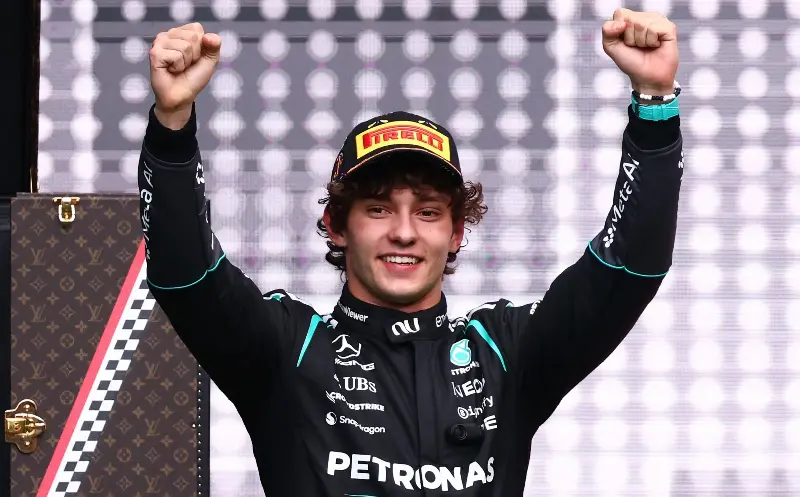
After finishing third in Mexico City, Kimi Antonelli became the youngest Formula One world champion at just 20 years and 68 days old, surpassing Sebastian Vettel’s record from 2010.
With that in mind, Telegraph Sport has ranked the championship-winning seasons of the youngest F1 champions. We are rating their debut titles and hence each driver has only one entry.
We considered several factors: how long the driver had been in F1 before they won the championship, their age at the time, the strength of opposition as well as their relative success (winning margin) and absolute success (percentage of available points scored).
There are also some subjective value judgments, because not everything in life can be boiled down to a scientific formula.
As impressive as Lando Norris’s world championship was, it is 10th for obvious reasons. He was 26 when he won this title, in his seventh season. He clinched it, in percentage terms, with the smallest winning margin in F1 history.
He managed to do it against Max Verstappen, though you can make the argument he should have won it before he did. Still, a strong finish to the season after a patchy start means Norris is a worthy world champion.
Niki Lauda’s most tumultuous and memorable season, 1976, came a year after his maiden championship, which he won aged 26 in his fourth full season on the grid. Lauda’s winning margin is the second highest in this list as he took nine poles and five victories from 12 races in his quick – and reliable – Ferrari 312T, which was introduced after the first two rounds.
The Austrian did not start it particularly strongly, in the old 312B, and only took the lead after his second victory at round six in Belgium. From that point on, though, Lauda did not look back and took the title (from Emerson Fittipaldi) in Italy no less, with a race to spare.
Vettel had already won a race for Toro Rosso before he became a Red Bull driver in 2009. In the second half of that season, Red Bull were regular winners and by 2010 Vettel had a championship-winning machine.
It was an extraordinarily close season: just 16 points separated the top four drivers after all 19 rounds and Vettel, who won three of the final four races, overturned a 21-point deficit to team-mate Mark Webber, overtaking Lewis Hamilton and Fernando Alonso in the process. High marks for strength of opposition but less impressive on the success metrics. No title in this list has a worse winning percentage than Vettel’s 26.3.
No driver has won the world championship in their first campaign since the first season of the F1 world championship. Antonelli is only the third driver to have done it in their second season since Juan Manuel Fangio in 1951, following Hamilton and Jacques Villeneuve.
Villeneuve, in fairness, took Damon Hill to the wire as his Williams team-mate in 1996, but managed to make up for that near miss with victory over Michael Schumacher – though officially Heinz-Harald Frentzen finished second after Schumacher’s disqualification – the following year. What stood out? Ten poles from 17 races and seven victories from 11 finishes. True, the Williams was the strongest car, but he still had to resist Schumacher in his pomp.
The first world title for Schumacher was a strange one, though perhaps one that sums up his career. He led Hill, the eventual runner-up, by 33 points after four rounds but was reeled back in, partly because of an amateurish disqualification at Silverstone, which then led to a two-race ban which was served later in the season.
In the 10 races that the German was classified, he won eight and finished second in the other two. He certainly showed his prowess, but he ultimately let himself down with his swipe on Hill in the decisive final race. Without that, he would be a place or two higher on the list.
Verstappen was such a preternatural talent that he was promoted to Red Bull in his second season and won on his race debut for the team. Yet it took him until his seventh campaign for him to have a car that had the potential to do anything beyond winning the odd race.
For all the arguments on how the Abu Dhabi Grand Prix should have ended, 2021 was terrific for Verstappen, with 10 victories. That he managed it against Hamilton at (or very close to) his peak earns him extra points, too.
Had Hamilton beaten Alonso and Kimi Raikkonen in his 2007 debut season, as you could argue he should have done, then he would have made the top of the list. As it is, his maiden title comes fourth. No doubt that winning in your second season is still a mightily impressive achievement – just not quite as impressive as victory in the first would have been.
The opposition was not as strong in 2008, as Alonso was replaced by Heikki Kovalainen in the second McLaren. That said, Ferrari had a strong line-up of Felipe Massa and Raikkonen, who was the defending champion. Wins were not plentiful – Hamilton also won just over a quarter of the races. The margin over Massa was also minuscule.
Alonso may have ended Schumacher’s run of five drivers’ titles with his first championship with Renault, but Ferrari were so poor for most of 2005 the German never had a realistic chance. Instead, it was a battle with McLaren’s Raikkonen that defined the Spaniard’s season.
Alonso built his title on a superb start, winning six of the first 12 rounds and making the podium in five of the other six. Schumacher may not have been much of a fixture – a thrilling duel in San Marino aside – but this was arguably Raikkonen’s finest season when it comes to raw performance, earning Alonso a good score for the level of competition.
For 33 years, Emerson Fittipaldi’s record as the youngest world champion stood, until Alonso beat it in 2005. That is apt because it was a toss up between those two for whose title is ranked second. The Brazilian’s maiden triumph would probably not make the top 10 in most people’s “most impressive” or “most memorable” championships, but this is unfair.
For one, Fittipaldi beat Jackie Stewart, who was at that point a two-time and defending world champion, by a reasonable margin of 16 points from 12 races, or by 26.2 per cent. The Scot did miss a race, but only Antonelli and Lauda have better ratings in this area.
*At the time of writing, with four rounds remaining
Antonelli tops this list because he comes out near the top in several important metrics. He won the title in his second season, did so at the age of 20 and has a win rate of approaching 50 per cent at the time of writing (second only to Schumacher in 1994 in this list). He is also on course to have a significant winning margin.
The only downside is the strength of opposition. George Russell was more highly rated going into 2026 and Hamilton is the most successful driver of all time – and Verstappen came too late to the party – but Antonelli never faced sustained pressure from either. Part of that, though, has to be down to how he drove in the early part of the season, when he won five races in a row.
The improvement he has demonstrated since a rocky debut season has been unfathomably fast. He has driven like a 10-year veteran throughout 2026, with few signs of weakness. Combined across all metrics, Antonelli comes out a comfortable winner.