



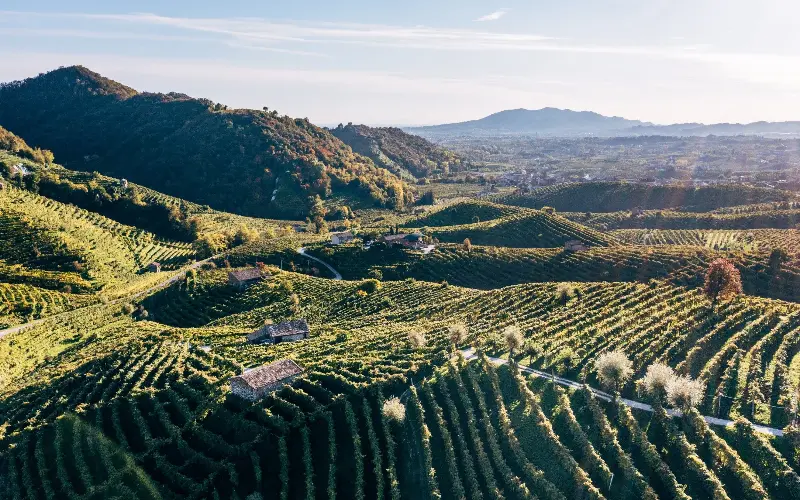
It wasn’t the usual place for a vending machine. Deep in rural Italy, the natural amphitheatre of Cartizze opened out before us in full splendour, its intricate patchwork of vines stitched across the valley floor, rising over hummocks and encircling hamlets as it ran towards wooded slopes.
My friend Suzanne and I were looking down from the Cartizze hills over some of the area’s most-prized vineyards. And the vending machines we found there (there were four of them) were brim full of prosecco.
Naturally, we picked a bottle, plus some cheese (also on sale), then settled in for an impromptu picnic in the Unesco-listed Prosecco Hills where they make the fizz, up in the Veneto’s Treviso province, in the north-east of the country.
And so what was meant to be a 10-minute break on our hike – part of a new self-guided walking holiday with specialist travel company Inntravel – easily slipped into an hour and a half’s sojourn as we rhapsodised over both the view and, surprisingly, the drink.
We’re both committed Champagne drinkers who’d normally steer well clear of Italy’s cheaper bubbly. And yet there we were, happily pouring another glass. As Suzanne said while she topped herself up: “This has totally changed my opinion of prosecco. Before, I wouldn’t have touched it with a barge pole.”
We hadn’t expected fine fizz as we set off on undulating walks from hotel to hotel through this ridiculously pretty slice of Italy. Medieval castles and chapels balanced on hilltops and small villages were tucked into folds of land, their tiled-roof houses clustered around the ubiquitous clock tower. Cuckoos called, crickets chirruped and vines festooned the long narrow ridges of hogback hills. Row after row of Glera, the grape behind prosecco, ran across steep terraces and rippling hillsides, often in criss-cross patterns rather than the straight, corduroy lines most associated with vineyards.
But our opinions shifted after our first day’s walk, when we strolled from our riverbank hotel in Pieve di Soligo to the three-hectare Cal Monda vineyard run by the trio of Dalla Betta brothers. “Look at this,” said Alberto, pointing on a map to a swathe of land that produces 667 million bottles of DOC Prosecco a year. “Now see this tiny bit around Conegliano and Valdobbiadene – it’s just 30km by eight km. This is where DOCG Prosecco is produced, which is totally different.”
He was right. After a tour of their biodiverse vineyard, with its wildflowers between the vines, bug hotels and beehives, we discovered their light, dry wine with minimal sulphites, including an extra brut with virtually no sugar and brut with only 8g per litre. They were a million miles from cheap supermarket plonk.
Thus enlightened, it would have been rude not to stop on our walk the next day at La Casa Vecchia, which appeared right on our route just before lunchtime. And not just for its loos and panoramic terrace.
One glass quickly became three as we established the quality and experimented with different types, trying the less fizzy frizzante as well as spumante (prosecco also comes in a still form known as tranquillo – who knew?).
“We don’t call it prosecco. We call it Valdobbiadene DOCG to differentiate it,” said fourth-generation winemaker Emanuele Follador. The bill? Six glasses cost just €19 (£16.50), plus another €10 (£8.60) for the bottle I added to my backpack.
Things went a bit wobbly after that. Even after scoffing our picnic lunch to sop up the excess alcohol, we somehow missed our way and ended up scrabbling up a smaller, albeit scenic, path up a steep hillside amid the vines. All I can say is that hiking poles are a game changer.
We eventually reached the village of San Pietro di Barbozza and the best hotel of the trip, Municipio 1850, where our luggage awaited in comfy rooms with sweeping views over the vines. It’s owned by the Rebuli family, who also run the excellent restaurant Trattoria Alla Cima and the adjacent vineyard. And yes, their prosecco goes down a treat.
Two nights here gave us time to dip into the Anello del Prosecco Superiore trail, looping through the steep, neatly combed hillsides around San Pietro and the neighbouring village of Santo Stefano, its white clock tower poking above a sea of vines. This is Cartizze country, just 108 hectares (about one square kilometre) of elite prosecco production carved into a mosaic of tiny plots, some at almost absurd angles.
There are plenty of places to try it as well as other sparkling styles at family-run vineyards such as Colosel and Tanore. We dropped in on both for a quick tasting before hitting the surreal vending machine nearby. Back in San Pietro, Varaschin pairs its wines with a historic frescoed cellar that has hosted the Confraternity of Prosecco since 1946, a group whose mission is to promote the drink.
Of course, there were distractions other than prosecco as the week unfolded, including a medieval church with fading frescoes in Susegana, the beautifully preserved cloisters of a 13th-century Cistercian abbey in Follina and a poignant cemetery in a forest glade dedicated to Italy’s elite mountain infantry corps near Cison di Valmarino.
And the scenery did a lot of the talking as we clocked up to 22,000 steps a day on terrain that was far from flat – this is not somewhere to hike in the height of summer. But in the spring sunshine, it was perfectly manageable for two relatively fit ladies of a certain age armed with Inntravel’s detailed route notes (much of the way isn’t signposted). Walks generally took about four hours, unless we lingered a little too long on either prosecco or the views.
These peaked as we headed into the foothills of the pre-Alps – Heidi country criss-crossed by vines – on our longest hike of about nine miles. After hours of walking, we spied the sprawling castle-turned-luxury retreat of Castelbrando looming on a distant hillside. It was the last hotel of the hike – but to get there, we had to haul ourselves up the hill.
At the top, the reward was immediate: sweeping views over crenellated walls and a spa where we could soak tired muscles in outdoor hot tubs while gazing over the valley. And there, among the sauna and steam rooms, we found one dedicated to wine therapy, with a very distinct bouquet. There could have scarcely been a finale more fitting.
Essentials
Inntravel has seven nights’ B&B from £1,358pp, including two dinners and three picnics, plus baggage transfer between hotels. Flights to Venice and transfers cost extra. Holidayextras.com has eight days’ parking at Stansted from £119.