


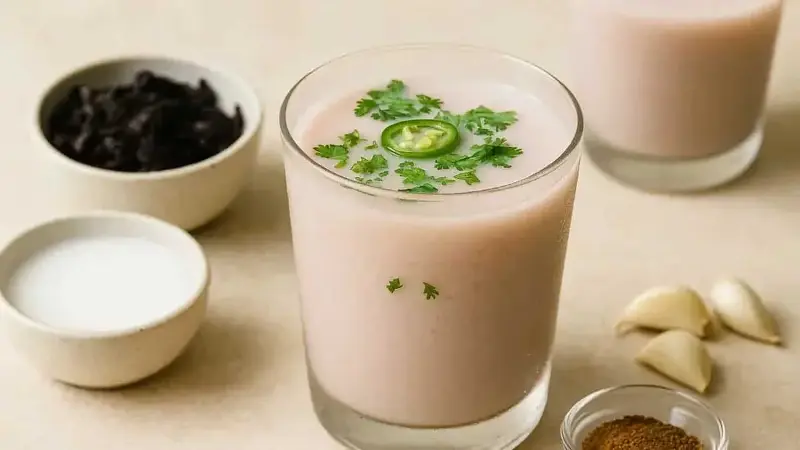
A good solkadhi hits like a cool tide after heat: pale blush from kokum, coconut-soft at the edges, with garlic and chilli arriving late—more perfume than punch. No fresh coconut, no grating, no squeezing: one can, one souring agent (kokum), ten minutes—then you can riff.
What This Simplified Solkadhi Delivers
Solkadhi, in practical terms, is a chilled drink of kokum + coconut + a few aromatics (often garlic, green chilli, cumin, curry leaves), balanced with salt and diluted to a light, drinkable texture. It should be tangy, creamy, lightly spiced, refreshing—and not sweet like a dessert drink.
This shortcut lands the core idea: kokum’s clean, plum-like sourness against coconut’s roundness, with a savoury backbone. What it won’t fully replicate is the fresh-pressed coconut aroma. Canned coconut milk can read richer and denser; the fix is simple and non-negotiable: dilution. When you take it to “thin buttermilk” consistency, the drink tastes bright again instead of heavy.
If you want the light context—Konkan coast, often served after meals—read coastal Konkan food trails.
Ingredients + Smart Shortcuts
Kokum: choose your format
You can make a reliable solkadhi with any of these; your choice is mostly about speed.
- Dried kokum (amsul): best flavour and colour control, needs a quick soak.
- Use when: you can spare 5–10 minutes.
- Kokum concentrate/extract: fastest and consistent.
- Use when: you want true “10 minutes, no prep.”
- Kokum syrup (often sweetened): not ideal for classic solkadhi.
- Use only if that’s all you have; go slowly and skip any extra sugar.
Canned coconut milk: what to buy (and what to avoid)
- Buy: unsweetened coconut milk (the kind meant for curries).
- Avoid: cream of coconut (sweetened cocktail mixer) and anything labeled sweetened.
- Note: coconut cream is thicker/fattier than coconut milk—usable, but it needs more water to stay drinkable.
Core aromatics (minimal, defining)
Start modestly; you can always add.
- Garlic: 1 small clove per 2–3 glasses (use 1/2 if you’re unsure)
- Green chilli: 1 small, slit or finely chopped (use half for mild)
- Cumin: 1/4 tsp (earthy base note)
- Curry leaves: 6–8 (optional but signature)
- Coriander leaves: 1–2 tbsp chopped (fresh lift)
Balancing basics
- Water ratio mindset: canned coconut milk needs dilution to avoid a “coconut gravy” feel.
- Salt: makes the coconut taste more “milky” and rounds kokum’s sharpness.
- Optional: a tiny pinch of jaggery/sugar only if it still tastes too sharp after salting.
Example substitutions: no curry leaves → skip; no coriander → try a little mint (see twists).
10-minute solkadhi (step-by-step with dilution ratios)
Makes: 2–3 glasses (about 600–750 ml total)
Base recipe (exact quantities)
- Unsweetened canned coconut milk: 200 ml (about 3/4 cup)
- Water: 400 ml (1 2/3 cups)
- Kokum (choose one path below)
- Garlic: 1 small clove, finely grated or crushed
- Green chilli: 1 small, finely chopped (or 1/2 for mild)
- Cumin: 1/4 tsp, lightly crushed
- Curry leaves: 6–8, torn (optional)
- Coriander leaves: 1–2 tbsp, chopped
- Salt: 1/2 tsp, then adjust
Target texture cue: drinkable like thin buttermilk, not spoonable.
Step 1: Kokum prep (two fast paths)
A) Dried kokum quick soak (best flavour control)
- Rinse 6–8 dried kokum petals.
- Soak in 150 ml hot water for 5–8 minutes.
- Rub/squeeze the kokum into the water, then strain. You’ll use this pink-red liquid.
B) Kokum concentrate (fastest)
- Start with 1 to 1 1/2 tsp concentrate in a bowl.
- Mix with 150 ml water.
- Taste and adjust later (concentrates vary in strength).
Step 2: Dilution guidance for canned coconut milk
- In a jug, whisk 200 ml coconut milk + 400 ml water until fully smooth.
- Brand variance note: if your coconut milk is already thin, hold back 50–100 ml water and add only if needed.
- Thickness check: if it pours like a light sauce, add 2–4 tbsp water and whisk again.
Starting ratio to remember: 1 part canned coconut milk : 2 parts water.
Step 3: Mixing order (to avoid graininess/splitting)
- Whisk coconut milk + water first (make it uniform).
- Add the prepared kokum liquid slowly while whisking.
- Stir in garlic, chilli, cumin, curry leaves, coriander, salt.
- Strain (optional but recommended) for a clean, drinkable finish.
Step 4: Chill fast and serve
- Best flavour: refrigerate 15–20 minutes.
- Fastest: pour over ice and serve immediately.
- Ice keeps diluting as it melts; if you’re using a lot of ice, season a touch higher.
Nutrition varies by brand and dilution. Check solkadhi nutrition with your coconut milk brand and final volume.
5 Flavour Twists
These are designed per-glass (200–250 ml) so you can experiment without risking the whole batch. Start small, taste, then scale.
Twist 1: Mint-coriander refresher (brighter, greener)
Add per glass:
- 1 tbsp mint, finely chopped
- 1 tbsp coriander, finely chopped
- Pinch of salt
Twist 2: Ginger-pepper kick (warm heat, not just chilli)
Add per glass:
- 1/2 tsp ginger, finely grated
- 1/8 tsp black pepper, freshly crushed
Heat balance note: ginger reads sharper when warm—serve this one extra cold.
Twist 3: Jeera-lime cooler (roasty + extra tang)
Add per glass:
- 1/4 tsp roasted cumin powder
- 1 tsp lime juice
Caution: lime stacks sourness on kokum. If it turns sharp, add a pinch of salt first; if still sharp, add a tiny pinch of jaggery/sugar.
Twist 4: Curry leaf tadka (toasty aroma bloom)
Do this for the whole batch:
- Heat 1 tsp oil in a small pan.
- Add 8–10 curry leaves.
- Optional: 1/8 tsp cumin seeds.
- Pour the sizzling tadka over the solkadhi, stir, and let it rest 5 minutes before chilling.
Twist 5: Coconut water swap (lighter body)
For the base recipe, replace 200 ml of the water with 200 ml coconut water.
Effect: lighter body with a faint sweetness (you usually won’t need jaggery/sugar).
Want to keep riffing beyond these five? Build your own herb-and-spice twist with Cocktail Sifter.
Troubleshooting + Make-Ahead Storage
- Too sour: dilute with water (start with 2–3 tbsp per glass), then re-check salt. If it’s still sharply sour, add a tiny pinch of jaggery/sugar. Avoid fixing sourness with more coconut milk alone—it turns heavy.
- Too thick/rich: whisk in 60 ml water for the batch, or 2–4 tbsp per glass. After diluting, add a small pinch of salt.
- Split/grainy (common causes: very cold coconut milk hitting acid; aggressive blending): let it sit 2–3 minutes, whisk thoroughly, then strain. Next time, follow the whisk order and avoid boiling.
- Too garlicky/spicy: strain, dilute slightly, add more coriander or a little mint, then chill—cold softens garlic’s edge.
- Storage: best within 24 hours, refrigerated. Whisk or shake before serving. Avoid storing with ice inside the batch (uneven dilution).
Questions about substitutions or a new kokum brand? Share your version and get help in the Slurrp community.
Serving Notes: When And How To Drink It
Solkadhi shines when you want refreshment without sweetness: after a meal (especially something oily or spicy), or as a mid-afternoon cooler that feels more like a savoury lassi than a juice.
- Portion: 200–250 ml per person; for a heavy meal, smaller glasses are enough.
- Garnish (choose one): a few torn curry leaves, chopped coriander, or a thin slice of green chilli floated on top.
- What to pair (2–3 easy wins):
- spicy fish fry or prawn dishes
- veg thali with dal + bhaji + rice
- any fried snack (kothimbir vadi, pakoras) when the weather’s hot
Browse more quick drink ideas: discover more recipes.
Conclusion
If your glass tastes kokum-forward, gently coconut-rounded, and seasoned enough that it doesn’t feel flat, you’re there. Adjust salt first, then tweak sourness at the end (especially with concentrates)—and keep experimenting per-glass until you find your house version.
Some parts of this article were created with AI assistance.