



An online lesson takes an extra second to load. The wait may seem trivial, but in a study examining large learning platforms, these brief pauses were linked to unfinished assignments, lower scores and less time spent on the site.
The findings suggest that the digital divide extends beyond whether students can get online. As the researchers put it, "Having a connection is not the same as having a fast connection."
Asaf Mazar of the University of Pennsylvania and colleagues examined school mathematics and self-directed coding lessons for their study in Nature Human Behaviour. They also tested whether deliberately adding short waits could discourage people from finishing a reading task.
When a second matters
The first data set covered nearly 229,000 assignment attempts by 26,707 students using ASSISTments, an online mathematics platform, used in hundreds of U.S. schools.
The students rarely sat through lengthy loading screens: 94% of recorded loads lasted less than three seconds, but even within that short window, longer waits were associated with worse outcomes.
In the main analysis, each additional second of loading time was associated with a 1.1-percentage-point reduction in assignment completion and a 0.7-point drop in scores on a 100-point scale. Students also needed more separate sessions to finish their work.
There was a clue to what might be happening. After a longer load, students were more likely to leave the assignment untouched for at least another 10 seconds—a possible sign that their attention had moved elsewhere.
To isolate the causal effect of the delays, the researchers compared each student's faster and slower loading experiences, while accounting for factors including the assignment and time of day. This helped separate the delays from stable differences between students, although changing circumstances could still influence the results.
Easier to click away
The second study reported in the same paper examined freeCodeCamp's Spanish-language site, where learners complete coding projects through a series of short lessons. Most users were in Latin America, and the main analyses covered more than 55,000 user IDs.
An additional second of loading time was associated with a 4.6-percentage-point reduction in the likelihood of keeping the learning tab in focus for more than a minute. That measure tracked which window was active, rather than directly measuring attention or comprehension.
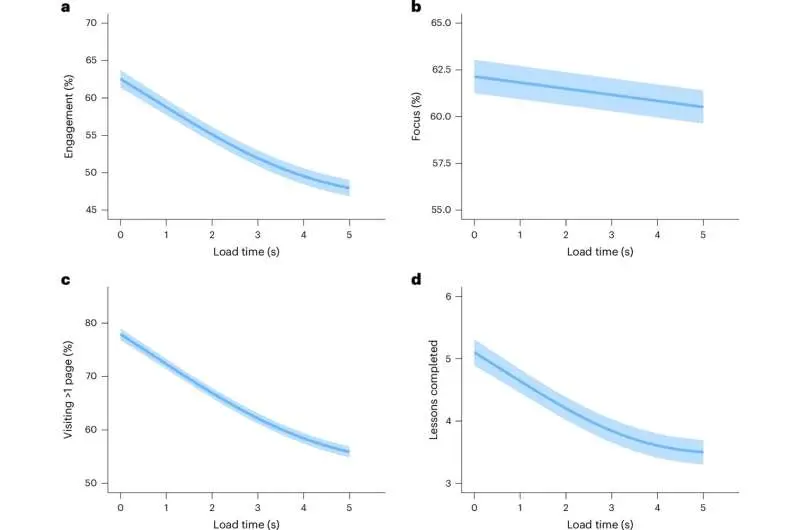
Learners facing longer waits also completed fewer lessons and spent a smaller share of their visit with the learning tab in focus.
The researchers suggest that self-directed learners may be particularly vulnerable to these interruptions because switching away is easy. Interacting with teachers and engaging in classroom routines might help school students stay on task. The study did not directly test that theory, but the findings point to why the same brief wait could matter differently in different settings.
Putting the wait to the test
Analysis of the platform records in the first two studies could not rule out every alternative explanation. A separate randomized experiment gave the researchers a more direct test.
A total of 598 adults who had opted to read popular science material were split into two groups: one was given a seamless reading experience and the other saw three-second loading screens before each page. About 70% finished the reading task without the added delays, compared with 54% when the pauses were imposed.
That result strengthens the case that brief waits can reduce persistence. The broader study mainly measured immediate engagement and assignment performance, however, rather than long-term learning or final grades. And without individual income data, it also could not establish if disadvantaged learners were more greatly impacted by the delays.
For education technology developers, the findings pose a practical problem. A feature that enriches a lesson on a fast connection may introduce disruptive waits on a slower one. The authors propose adapting platforms to connection speed, much as streaming services lower video quality to keep playback moving.
Written for you by our author Andrew Zinin, edited by Lisa Lock, and fact-checked and reviewed by Robert Egan—this article is the result of careful human work. We rely on readers like you to keep independent science journalism alive. If this reporting matters to you, please consider a donation (especially monthly). You'll get an ad-free account as a thank-you.
Publication details
Asaf Mazar et al., Microdelays disrupt online learning, Nature Human Behaviour (2026). DOI: 10.1038/s41562-026-02598-y
Who's behind this story?

Andrew Zinin
Master's in physics with research experience. Long-time science news enthusiast. Plays key role in Science X's editorial success. Full profile →

Lisa Lock
BA art history, MA material culture. Former museum editor, paramedic, and transplant coordinator. Editing for Science X since 2021. Full profile →

Robert Egan
Bachelor's in mathematical biology, Master's in creative writing. Well-traveled with unique perspectives on science and language. Full profile →
© 2026 Science X Network
Citation: A few seconds of loading time can push online learners off track (2026, October 25) retrieved 25 October 2026 from https://phys.org/news/2026-10-seconds-online-learners-track.html
This document is subject to copyright. Apart from any fair dealing for the purpose of private study or research, no part may be reproduced without the written permission. The content is provided for information purposes only.