



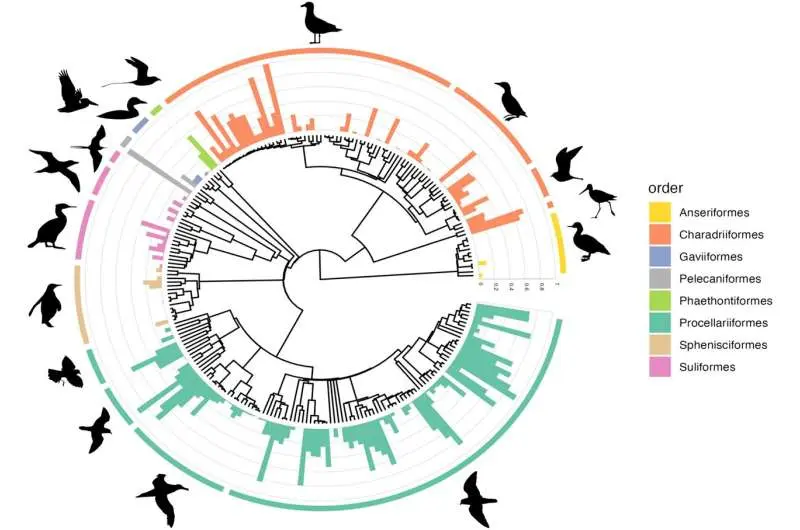
What seabirds eat might seem like a good starting point for identifying species that tend to accumulate plastic in their digestive systems. Yet a recent global analysis suggests that mapping the evolutionary relatives of birds could offer better clues than their diets or feeding methods alone.
Researchers at the University of Queensland, London's Natural History Museum and other institutions assembled records covering 93,281 birds belonging to 240 distinct species. In their models, outlined in Biology Letters, evolutionary relationships were found to be the strongest predictor of plastic occurrence in seabirds.
In contrast, the birds' diet, feeding method, body size and specialization in open-ocean feeding showed no consistent effects after the researchers accounted for relatedness and differences among studies.
Following bird family branches
The researchers combined information from 262 sources published between 1958 and 2024. They focused on the proportion of birds in each sample that presented signs of having consumed plastic, rather than the number of plastic pieces each bird contained.
This widely available measure, known as frequency of occurrence, allowed the team to compare the findings of many studies.
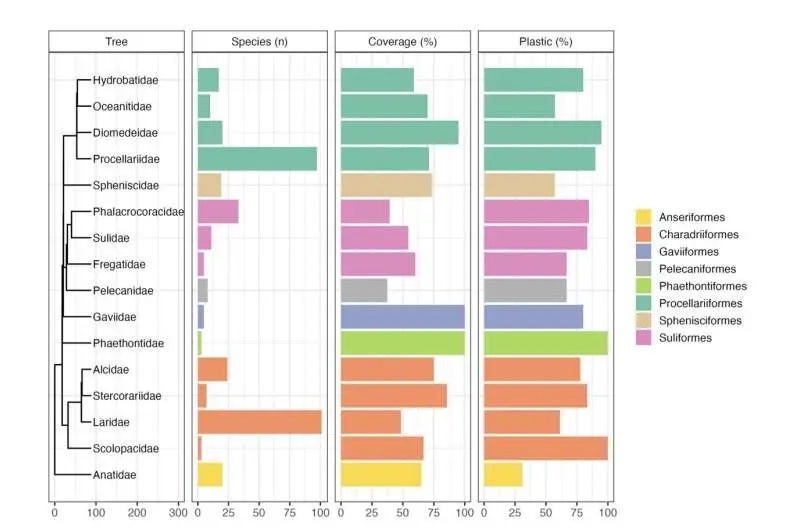
They found that plastic had been recorded in 182 of the 240 sampled species. This means that about three-quarters of sampled species (not individual birds) had at least one record of plastic ingestion.
The researchers then produced models using records covering 82,406 birds from 230 species. They excluded species lacking complete ecological information and samples consisting solely of nest-bound chicks, which do not forage for themselves.
The team compared records of plastic occurrence with the species' lifestyles and positions on an evolutionary family tree, which represents their shared ancestry. Their models accounted for differences in the sampling methods employed across studies, study years, publications, the age groups of the birds and the ocean basins considered.
Closely related species tended to show similar patterns of plastic occurrence. "This does not mean ecological traits are unimportant," the researchers wrote in their paper.
Related species often share feeding habits and other characteristics, including traits that the analysis did not measure. The broad categories used in the analysis to describe a species' lifestyle may also miss finer differences in behavior.
Other hints of plastic ingestion in seabirds
Swallowing plastic and retaining it in the gut are different processes. Some seabirds expel indigestible material in pellets, while others retain it and excrete it slowly. A bird with little plastic in its stomach could therefore have swallowed as much as one that contains more in its gut.
These differences in the processing of indigestible materials are also linked to evolutionary relationships. As the researchers lacked comprehensive information about gut retention rates in different species, retention remains a possible explanation for the observed patterns, rather than a mechanism established across all the species studied.
The team's analysis captures the combined effects of ingestion and retention without measuring them separately. It also cannot establish how much plastic birds encounter, as they may have swallowed debris far from where they are sampled.
Detecting plastic does not reveal its quantity or the harm it causes. Moreover, samples often came from stranded birds or birds caught in fishing gear, potentially overrepresenting unhealthy or stressed individuals.
Despite these limitations, the authors suggest that evolutionary relationships could provide "a rapid first screen for identifying species likely to accumulate plastic."
In future studies, the researchers propose generating accumulation-risk predictions for the 143 species without records, then prioritizing the sampling of birds for which the predicted risk of plastic accumulation is higher. Testing those predictions in overlooked species would help to establish the potential of bird family trees as tools to guide targeted investigations of plastic accumulation.
Written for you by our author Ingrid Fadelli, edited by Gaby Clark, and fact-checked and reviewed by Robert Egan—this article is the result of careful human work. We rely on readers like you to keep independent science journalism alive. If this reporting matters to you, please consider a donation (especially monthly). You'll get an ad-free account as a thank-you.
Publication details
Stephanie Avery-Gomm et al., Frequency of plastic occurrence varies across phylogeny but not ecology in seabirds, Biology Letters (2026). DOI: 10.1098/rsbl.2026.0079
Who's behind this story?

Ingrid Fadelli
Freelance journalist with BSc Psychology and MA International Journalism. Covers AI, robotics, neuroscience, and astrophysics since 2018. Full profile →

Gaby Clark
MA in English, copy editor since 2021 with experience in higher education and health content. Dedicated to trustworthy science news. Full profile →

Robert Egan
Bachelor's in mathematical biology, Master's in creative writing. Well-traveled with unique perspectives on science and language. Full profile →
© 2026 Science X Network
Citation: Seabird family tree predicts which species accumulate plastic better than diet, global analysis finds (2026, October 24) retrieved 24 October 2026 from https://phys.org/news/2026-10-seabird-family-tree-species-accumulate.html
This document is subject to copyright. Apart from any fair dealing for the purpose of private study or research, no part may be reproduced without the written permission. The content is provided for information purposes only.