


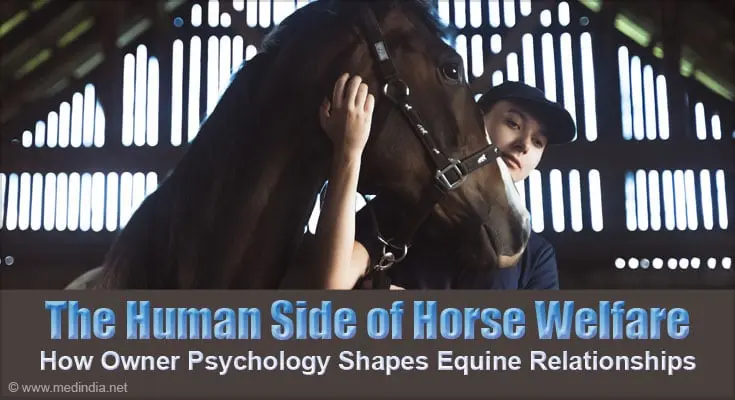
India, June 13 -- Horse ownership is often associated with riding skills, training techniques, feeding routines, and daily care. However, new research suggests that what happens inside the owner's mind may be just as important as what happens in the stable.
A new international study published in Anthrozoos found that horse owners' attachment styles and personality traits are linked to how frequently they ride, train, and spend quality time with their horses and even to the equipment they choose to use.
The findings suggest that the emotional patterns people bring into human relationships may also influence how they build relationships with horses.
Researchers surveyed 2,239 horse owners from 21 countries and examined how attachment styles, personality traits, relationship duration, training habits, and equipment preferences were connected.
According to the study, understanding these psychological characteristics could help improve human-horse communication, guide training approaches, and ultimately support better horse welfare.
The findings also fit into a growing body of equine welfare research showing that both human psychology and horse behavior contribute to the quality of the human-horse relationship.
How Do Horse Owners' Attachment Styles Shape Their Relationship With Horses?
According to the study, attachment style emerged as one of the strongest predictors of how owners interacted with their horses.
Attachment theory was originally developed to explain emotional bonds between people. Individuals with avoidant attachment tend to maintain greater emotional distance and rely less on close relationships, while those with anxious attachment typically seek stronger emotional closeness and reassurance.
Researchers found that horse owners with higher avoidant attachment scores generally interacted less with their horses. They spent less time riding, performed less groundwork training, and engaged in fewer quality-time activities.
In contrast, owners who showed lower levels of emotional distancing tended to spend significantly more time with their horses. The strongest association was observed with informal quality time, such as simply being present with the horse without a specific riding or training goal.
The study also found that relationship length mattered.
Owners who had known their horse for more than 10 years showed approximately 15% lower avoidant attachment levels compared with owners whose relationships were less than a year old.
According to the researchers, this suggests that emotional bonds may strengthen through years of repeated positive interactions.
Lead author Oceane Liehrmann from the University of Turku and the Swedish University of Agricultural Sciences noted that similar patterns have previously been observed in companion animal research, where people with more avoidant attachment styles tend to be less engaged in pet care and interaction.
Can Spending Quality Time With Horses Strengthen the Human-Horse Bond?
The findings suggest that the type of interaction may be just as important as the amount of interaction.
Owners who frequently spent informal, unstructured time with their horses showed stronger emotional connections than those who primarily engaged with horses only for riding or training purposes.
According to the researchers, quality time reflects relationship-building rather than task-focused activity. Simply spending time together may allow owners and horses to develop familiarity, trust, and mutual understanding.
Evidence from broader equine welfare research supports the importance of social and emotional connections.
A study published in Animal Behaviour found that horses given opportunities for regular social contact with other horses displayed fewer stereotypic behaviors, fewer negative reactions toward humans during grooming sessions, lower vigilance levels, and more positive emotional states than horses without social interaction. (2)
Researchers concluded that even temporary but regular social contact improved horses' emotional well-being. Horses allowed daily interaction with other horses appeared calmer, more relaxed, and more positive during human handling than isolated horses did.
Together, the two studies suggest that strong social relationships matter for both sides of the partnership. Just as owners who spend more meaningful time with their horses develop stronger bonds, horses also appear to benefit emotionally from positive social experiences.
Which Personality Traits Influence Riding and Training Habits?
Beyond attachment styles, the researchers also examined how personality traits influenced equestrian behavior.
The study found that owners who rode more frequently tended to be slightly more conscientious, more outgoing, and more emotionally stable than less frequent riders. These individuals generally appeared more organized and confident in their approach to horse-related activities.
Meanwhile, owners who practiced groundwork training more often scored higher in openness to experience. Groundwork involves handling and training exercises performed from the ground and is often associated with alternative or horse-centered training approaches.
Researchers suggest that naturally curious individuals may be more willing to explore training methods beyond traditional riding-focused activities.
Although the personality differences observed were relatively modest, they were consistent across the large international sample.
The owner's personality, however, is only one side of the relationship. A study published in the Cluj Veterinary Journal identified 24 behavioral traits commonly used to describe horse temperament and proposed four broad horse personality categories: energetic and reliable, energetic and unreliable, passive and reliable, and passive and unreliable. (3)
The researchers noted that recognizing these temperament differences can improve training, communication, handling, and welfare outcomes.
Different horses may respond differently to the same training method, meaning successful partnerships often depend on understanding the behavioral characteristics of both the horse and the owner.
New Study Suggests Neurobiological Basis of Human-pet RelationshipNew Study Suggests Neurobiological Basis of Human-pet Relationship
Researchers have discovered how important brain structures are activated when women view images of their children and of their own dogs.
What Does Headgear Choice Reveal About Horse Owner Psychology?
One of the more unexpected findings involved the type of headgear owners used while riding.
The study found that owners who used bitless equipment or alternated between bit and bitless options tended to score lower on emotional distancing than those who rode exclusively with a bit.
Owners who used both types of headgear also tended to score higher on openness to experience, suggesting a greater willingness to explore different riding methods and management approaches.
However, the researchers stressed that these differences were relatively small and should not be interpreted as evidence that one type of equipment is inherently better than another.
Headgear choices are influenced by many factors, including riding discipline, training philosophy, owner experience, and the individual horse's needs.
Instead, the findings suggest that psychological characteristics may subtly influence how owners approach decisions throughout a horse's life, including training strategies and equipment preferences.
Could Understanding Equestrian Psychology Help Improve Horse Welfare?
The researchers believe the findings have important implications for horse welfare and owner education.
Previous research has shown that owner attitudes, knowledge, experience, and management decisions can directly influence equine well-being. The new study adds another layer by suggesting that psychological factors may also shape those decisions.
This conclusion is supported by a review published in Animals, which found that horse owner attitudes, knowledge, experience, and behavior are important determinants of horse welfare. (4)
The researchers noted that decisions involving feeding, housing, exercise, hoof care, parasite control, dental care, and veterinary treatment are often influenced by the owner's beliefs and understanding of horse management.
The review also highlighted that many welfare problems in recreational horses stem from management practices rather than intentional neglect. Improving owner awareness, education, and understanding of horse needs could therefore help improve welfare outcomes.
According to the authors of the new Anthrozoos study, greater awareness of attachment styles and personality traits could help create more tailored training programs and improve communication between horses and owners.
When viewed alongside evidence showing that horses benefit from social contact and that individual horse personalities influence behavior and learning, the message becomes clear: horse welfare is shaped not only by nutrition, healthcare, housing, and training methods but also by the quality of the relationships owners build with their horses.
The researchers conclude that helping equestrians understand their own psychological tendencies may encourage more thoughtful, horse-centered decision-making. Over time, greater awareness of how personality, attachment, attitudes, and behavior influence the human-horse relationship could strengthen partnerships and contribute to better welfare outcomes for horses.