


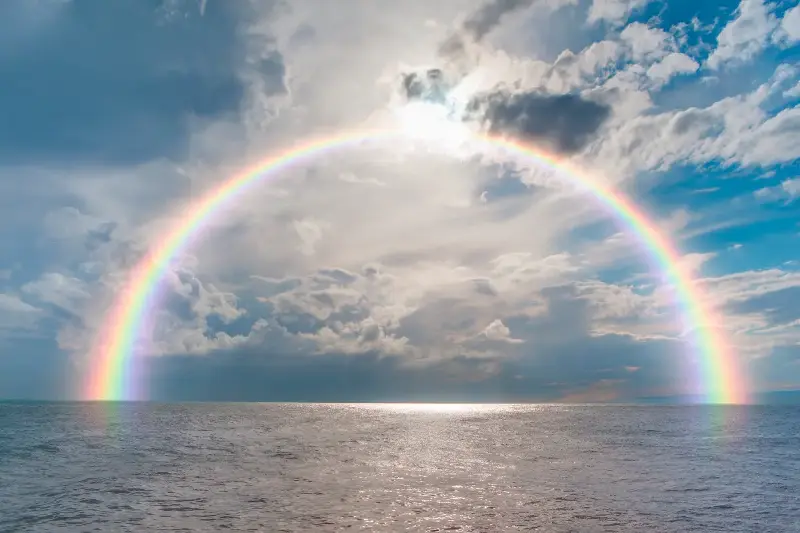
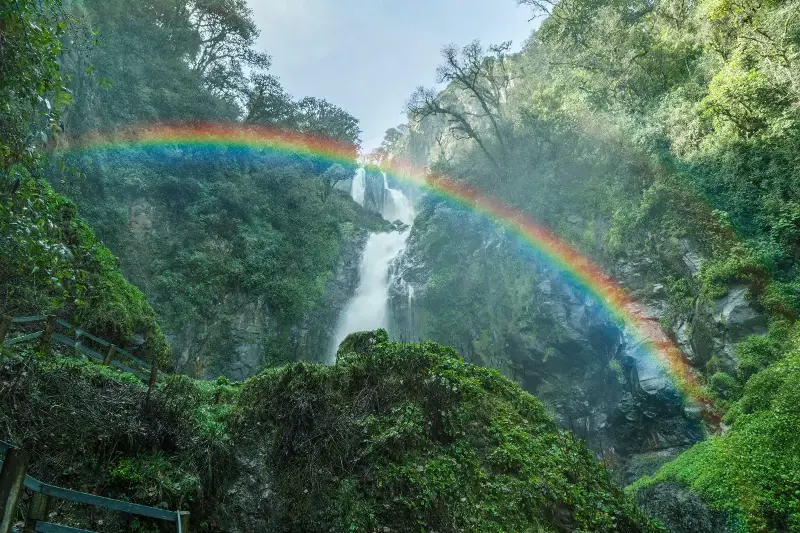
Across the world, few sights in nature are as delightful and universally enchanting as a rainbow. Whether it stretches across a clear sky after rain or appears as a faint arc over a shimmering waterfall, a rainbow possesses a magical quality that captures our collective imagination. But what exactly creates these vibrant ribbons of color? The answer lies deep within the fascinating worlds of physics and meteorology, where sunlight and water perform a dazzling, scientific dance.
HOW SUNLIGHT BECOMES A SPECTRUM
While we often view rainbows as a simple trick of light, the science behind them traces directly to the inherent properties of sunlight. Despite its golden glow, sunlight is not a single color; it is a brilliant blend of all visible colors.
- The Prism Effect: When light travels in a straight line, it appears white. However, when it encounters water droplets, those hidden colors are revealed.
- Refraction and Dispersion: A rainbow begins when sunlight enters a raindrop. Water acts like a natural prism, bending—or refracting—the light. Because each color travels at slightly different speeds in water, they bend at different angles. This process, known as dispersion, unfurls the entire visible spectrum.
- The Sequence: As light reflects off the back of the raindrop and exits, it separates into the sequence we know as ROYGBIV: red, orange, yellow, green, blue, indigo, and violet.
WHY RAINBOWS ARC ACROSS THE SKY
The graceful curve of a rainbow is not a random occurrence; it is defined by the precise geometry of light reflection within millions of tiny droplets.
For a single raindrop, the angle between the incoming sunlight and the outgoing color hitting your eye is approximately 42 degrees for red and slightly less for violet. Because rainbows depend on many drops sending light back at these specific angles, only those in a particular position in the sky will collectively produce the arc you witness. This is why all rainbows share the same basic shape, with red on the outer edge and violet on the inside.
If you were to view a rainbow from an airplane, you might notice that it actually forms a complete, perfect circle—a sight usually hidden from the ground by the horizon.
WHY NO TWO PEOPLE SEE THE EXACT SAME RAINBOW
One of the most surprising facts about rainbows is their personal nature. The rainbow you see is technically unique to you. Because the arc of light depends on the exact angle between the sun, the droplets, and your eyes, the rainbow is a private optical experience. Even if you are standing next to someone else, you are viewing light emerging from different droplets. If you move just a few steps, the rainbow you perceive subtly shifts, ensuring that your view is truly one-of-a-kind.
THE MAGIC OF DOUBLE AND RARE RAINBOWS
Sometimes, a lucky observer will spot a fainter, larger arc outside the main rainbow. This is a double rainbow, caused by sunlight reflecting twice inside the raindrop before it exits. This second reflection reverses the color order—red appears on the inside, and violet on the outside.
Beyond these, nature offers other rare forms:
- Supernumerary Rainbows: These feature extra, delicate pastel bands caused by light waves overlapping.
- Fogbows: Pale, white arcs that form when sunlight strikes tiny fog droplets.
- Moonbows: Ethereal rainbows that appear at night when the moon is bright enough to refract light through water droplets.

WHEN AND WHERE ARE RAINBOWS MOST LIKELY TO APPEAR?
For all their beauty, rainbows have predictable requirements. The perfect recipe includes sunlight paired with water droplets in the air.
- Timing: They are most common after a rain shower when the sun is low in the sky—typically in the early morning or late afternoon.
- Positioning: To see a rainbow, ensure your back is to the sun while the rain or mist is ahead of you.
- Locations: Hawaii is often celebrated as the "rainbow capital of the world" due to its frequent, localized showers and brilliant sunlight. However, you can create your own "man-made" rainbows using garden hoses or misting spray in your own backyard.
RAINBOWS IN CULTURE AND SCIENCE
Throughout human history, rainbows have served as timeless symbols of hope and promise. Beyond their rich cultural symbolism, they offer a tangible glimpse into the interplay of light and matter, reminding us of the extraordinary science occurring in our daily lives. Next time you gaze at a rainbow, remember the fascinating collaboration between the sun, the atmosphere, and tiny droplets. A rainbow may last only moments, but the wonder it inspires is enduring.